Why visual consistency is the wrong brief for retail interiors and what a room gains when it’s allowed to disagree with the one before it.
Walk through a shop with more than one room and notice where you actually slow down. It is rarely at the doorway between them. It is a few steps further in, once the light has changed, or the floor has, or something about the air tells you, without quite explaining why, that you have arrived somewhere new.
Most retail briefs ask for the opposite of this: one material palette from entrance to till, one tone of light throughout, one register repeated until it becomes the room’s whole personality. It reads as considered. It also reads as nothing in particular.
Why Retail Spaces That Don’t Match Feel More Considered Than Spaces That Do
The logic behind a consistent scheme is straightforward: remove friction, and the customer relaxes; a relaxed customer stays longer; a longer stay becomes a sale. It’s a reasonable chain of assumptions. The problem sits in the first link. Continuity and comfort are not the same thing.
A space with no variation is a space with nothing to register. The eye adjusts to a single atmosphere quickly, and once adjusted, it stops paying attention. This is the feeling of walking through a large retail chain and sensing, somewhere around the third fixture, that you’ve already seen the whole store. Nothing is wrong with it. There’s also nothing left to find.
Contrast works differently. A room that feels distinct from the one before it asks to be read again. That small effort re-orienting, noticing, adjusting is the beginning of attention, and attention is what most retail design is actually trying to buy. Dwell time gets discussed as a commercial metric, but what produces it is rarely comfort on its own. It’s curiosity.
The same principle applies at a much smaller scale than a flagship store. A boutique with two rooms or a recessed display can create the same sense of discovery through changes in light, material or proportion. Customers rarely pause because they’re told to. They pause because something changes.
The most effective retail interiors are not visually consistent. They are spatially coherent and those are entirely different things.
What Changes When a Customer Crosses Into a Room That Feels Different
Hermès’ new Maison on Bond Street illustrates this unusually well. Rather than forcing six historic buildings into one seamless interior, Denis Montel and the team at RDAI allowed each part of the building to retain its own atmosphere. Colour, material and proportion shift as customers move through the Maison, yet the experience never feels fragmented. The coherence comes from one underlying idea rather than one repeated visual language.
Few boutique retailers have six buildings to work with. Most have two rooms, or a mezzanine, or a recess behind the main display and the underlying question is identical regardless of scale: does the spatial sequence give the customer somewhere to go, or does it ask them to take in everything from the door?
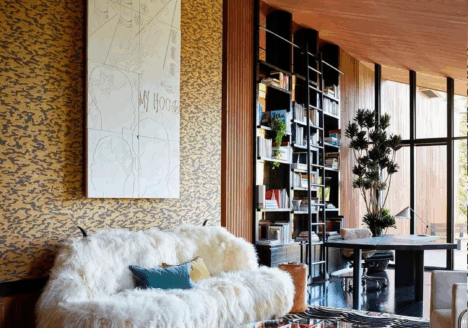
A low table beside a window changes how long someone stands there. So does a change in floor material at the exact point where browsing turns into considering something no sign could manage as quietly. Finish one wall differently from the one facing it, and the eye has a reason to keep moving. None of these are decorative choices. They’re spatial ones, and they show up in how long someone stays, whether they pick something up, and whether they start to imagine it at home.
The Difference Between Visual Consistency and Spatial Coherence
The distinction most retail briefs miss is this one. A consistent scheme repeats the same visual language throughout. A coherent one has a clear underlying logic and that logic can hold several registers at once without losing itself.
Aesop’s retail design works on the same principle from a different direction: not a single visual formula, but one spatial idea applied differently in every store. Hermès is coherent for the same reason. Every material change, every shift in colour, is in service of one idea that each métier deserves its own atmosphere, and that moving between them should feel like moving somewhere, not just somewhere else with different shelving.
For a boutique retailer, coherence starts earlier than the material palette. It starts with understanding what the space needs to communicate before deciding how it should look. A shop selling things people keep for twenty years shouldn’t feel like one selling something seasonal. Materiality, light, the pace of the route through the room all of it tells the customer something about value before a single object is in their hands.
The room that feels different is the one a customer remembers afterwards. The threshold into it is the point where a visit stops being a transaction and starts being something closer to an experience.
Coherence is not about everything matching. It is about everything meaning something.
The most expensive mistake in retail design isn’t the wrong material or the wrong light. It’s a brief that asks every room to behave the same way and gets exactly that, with nothing left over to remember it by.
Good retail design rarely comes from making every room look the same. It comes from giving each part of the journey a clear purpose. That is the principle Kando Studio brings to boutique retail interiors across London.
Written by Fariba Soltani, Founder of Kando Studio — kandostudio.com