What the most cautious rooms in retail and residential design are quietly communicating and why it costs more than people expect.
There is a particular kind of room that is very difficult to remember. You have been in it. It was clean, well-proportioned, inoffensively finished. White or close to it. Natural wood somewhere. Perhaps a warm grey. Nothing wrong. Nothing, really, at all.
The strange thing about these rooms is not that they fail. It is that they almost succeed. They are comfortable enough to remain in and forgettable enough to leave without noticing. In retail, the customer browses and moves on. At home, the occupant uses the room but never quite settles into it. The space functions. It just never becomes anywhere in particular.
This is not a problem of colour or material. It is a problem of commitment.
The Choice That Feels Like No Choice
The neutral interior is almost always chosen for the same reason: to avoid a wrong decision.
The developer finishing an apartment selects pale grey because it will not alienate buyers. The boutique owner chooses white walls and raw oak because it feels safe, considered, appropriately minimal. Neither is necessarily making a statement about restraint. More often, they are choosing the option that feels least likely to be questioned.
The result is a space that communicates exactly that. Not calm. Not refined. Undecided.
Spaces are read before they are understood. A customer entering a retail interior registers the room in the first few seconds, not consciously, but physically. The body decides whether to slow down or move through before the eye has finished scanning the shelves. A room finished without conviction gives the body no reason to pause. The customer keeps walking, sometimes without knowing why.
The same is true at home, over a longer timescale. A room that asks nothing of the person inside it receives nothing in return. The occupant uses it, passes through it, and gradually, without deciding to, spends their time somewhere else.
What Dwell Time Is Actually About
Layout explains where people go. It does not explain where they stop.
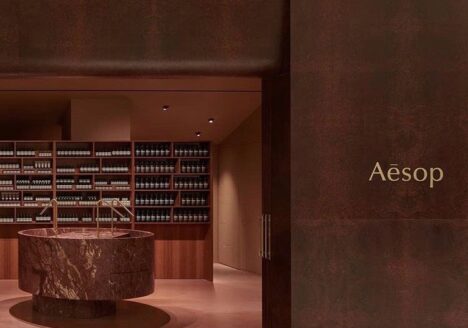
People stop where something asks them to. A wall surface with enough texture to catch the light differently as you move past it. A floor that shifts material at exactly the point where browsing gives way to considering. These are small decisions. They are not expensive ones. But they create the conditions for a customer to slow down, to look properly, to pick something up.
A customer who picks something up begins to imagine owning it. That sequence; pause, look, handle, imagine is where retail happens. The neutral interior, in trying to offend no one, removes the friction that starts it.
The Rooms People Actually Remember
Ask someone to describe a room they remember and they rarely begin with the neutral parts.
They will describe the kitchen with the deep green units their grandmother had, or the sitting room with the low ceiling and the window that faced the wrong way and somehow worked, or the hotel bathroom where the floor was cold stone and the towels were thick and somehow the combination stayed with them.
What these rooms share is not a strong palette or an unusual material. It is specificity. Someone made a decision and made it for a reason. The occupant may not be able to name the reason. They feel it every time they use the space.
This is where residential design is at its most useful. Not the creation of rooms that photograph well or hold their value on resale. The creation of rooms that become somewhere. That accumulate meaning over time rather than simply accumulating wear.
The Neutral That Works
There are quiet interiors that are not neutral in the way described here. The difference is almost always in the reason for the decision rather than the decision itself.
A pale wall can be the most considered choice in a room. It may be pale because of what the morning light does to it at a particular time of year, or because the joinery beside it needs that contrast to read correctly, or because the view from the window is the room’s real material and everything else should defer to it. That is not avoidance. That is restraint — which is a different thing entirely.
Avoidance is the absence of a decision. Restraint is a decision that knows what it is doing.
The trouble is that avoidance and restraint look almost identical in a specification document. They look different in a finished room. One settles. The other withholds.
Boutique retail design that works does not aim to appeal to everyone. It aims to appeal to someone specific and to make that person feel recognised the moment they step inside. The neutral interior, casting the widest net, catches the least. Not because it is wrong, but because it is not saying anything to anyone.
The rooms worth spending time in the shops worth returning to, the homes worth living in are almost always the result of someone deciding something. Not boldly, not dramatically. Quietly, and with attention. The neutral interior is not a safe choice. It is the choice that feels safe while the room quietly becomes nowhere at all.
Considered design is not about making spaces more dramatic. It is about making decisions with enough attention that the room becomes itself. Kando Studio works with retail and residential clients across London on interiors where every specification is made for a reason.
Written by Fariba Soltani, Founder of Kando Studio — kandostudio.com