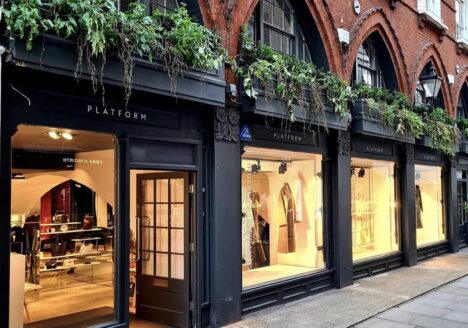
How lighting decisions shape atmosphere, customer behaviour, and dwell time in boutique retail interiors.
Walk into two boutiques on the same street. Same footprint, similar product. One feels considered — measured, warm, worth slowing down in. The other feels like a task to complete. You move through it faster than you intended, and you leave without being sure why.
Lighting is almost always the difference.
Retail lighting design is widely understood as a practical requirement — illuminate the product, make the space safe, meet the building code. What it is less often treated as is a spatial decision. A behavioural one. A decision that shapes how long a customer stays, how much they handle, and how much they trust what they are looking at. This is an observation Fariba Soltani, founder of Kando Studio, has made across retail fit-outs throughout London — and it begins almost always with a lighting decision that was made too late.
Most retail fit-outs treat lighting as a late consideration. Fixtures are specified after the layout is resolved, budgets have compressed, and the initial ambition of the space has already been diluted. What arrives is adequate illumination. Rarely atmosphere.
How Light Actually Behaves in a Retail Interior
Colour temperature is the variable most frequently misunderstood in retail lighting design. Cool white light — the default of many commercial fit-outs — reads as clinical. Efficient. Transient. Warm light, in the range of 2700K to 3000K, slows the body down in ways that are subtle but measurable. Customers linger longer in warmer light. Not because they decide to, but because the environment stops pressing them to leave.
Layering matters equally. A single overhead source flattens everything it touches — products, faces, materials. Three-dimensional objects lose their edge. Textiles lose their weave. Jewellery loses its depth. When lighting comes from multiple angles — ambient fill, directional accent, low-level warmth near seating or display — the eye has something to explore. Shadows give form. Form builds interest.
Thresholds deserve particular attention. The transition from street to interior is where a customer’s body reads the space before the mind processes it. A shop that floods its entrance with uniform bright light signals openness but sacrifices intrigue. A gradual shift in warmth and intensity — brighter at product, quieter at the transition point — creates a draw. Something changes. The customer moves toward it.
Contrast ratios, the relationship between lit surfaces and surrounding shadow, determine whether a space feels edited or exhaustive. High-contrast lighting with deliberate dark zones communicates selectivity. Uniform illumination across the entire floor plate at the same intensity communicates volume retail.
Directional accent lighting at 30–35 degrees from vertical brings out surface texture — in ceramics, in fabric, in leather goods. The shadow it creates is not a flaw in the design. It is information. Without it, the product is seen. With it, it is experienced. That is the difference between a customer looking at an object and a customer picking it up. As explored in the Aesop retail design analysis, material honesty only works when the lighting reinforces what the material is trying to say.
What Lighting Does to Customer Behaviour
Dwell time is the metric retail designers rarely discuss plainly, but it governs almost everything. A customer who spends three minutes in a space converts at a fundamentally different rate than one who spends eight. Lighting that creates atmosphere extends the time a customer wants to stay — not because they are waiting, but because they are not yet ready to leave.
Warmth in retail lighting functions similarly to warmth in hospitality. A restaurant that lights its tables well — low, directional, skin-flattering — is understood instinctively as one that cares about the experience of being there. The same logic applies to boutique retail. A customer who feels well inside a space is one who associates the brand with that feeling.
There is also the question of material honesty. Stone, timber, plaster, and textile all behave differently under light. A material specified with care, then lit poorly, loses its character — reads as lesser than it is, as imitation rather than substance. Lighting that works with materiality reinforces the quality of every other design decision in the space. It does not need to announce itself to do its work.
Why Lighting Must Be Specified Earlier
The persistent error in retail lighting design is treating illumination as the goal. Illumination is not the goal. Atmosphere is — and retail lighting design is the primary tool for building it. A boutique retail interior that has resolved its lighting has, in effect, resolved its customer experience. No amount of careful material selection or considered spatial planning will rescue a space that is lit without intention. The wrong light undoes the right room.
The practical principle is one of integration, not addition. Lighting should be specified at the point when spatial layout is resolved — not after. Colour temperature is decided alongside material selection, because the two are in conversation. A warm plaster wall reads entirely differently under 3000K than under 4000K. At close range, that is the difference between a wall that feels like a considered decision and one that feels incidental.
Dimming is underused in retail. Most commercial fit-outs are specified at a single intensity and left there. The ability to modulate light through the day — brighter at morning opening, quieter and warmer through the afternoon — mirrors the natural rhythm of light and aligns the space with the way people actually experience time. Across London boutique retail especially, this kind of considered control distinguishes the studio-designed space from the chain fit-out.
Retail lighting, when it is working, is invisible. What the customer feels is the space. What the space is doing is holding them there.
Working with Kando Studio
Good retail design is rarely only about display. It shapes how people move, pause, and experience a space. Kando Studio designs thoughtful retail interiors in London that balance atmosphere, functionality, and customer experience.
Written by Fariba Soltani, founder of Kando Studio — kandostudio.com