Small kitchens are often treated as problems to be solved.
Too tight. Too visible. Too compromised.
But looking closely at a handful of well-considered examples, it becomes clear that size isn’t the issue. What matters is attitude, how the kitchen chooses to belong to the home.
These four kitchens, all designed within compact apartments, take very different positions. None of them rely on trends or gimmicks. Instead, each responds to space, architecture, and daily life in its own way.
Together, they show that there isn’t one “right” solution for a small kitchen — only intentional ones.

1. The Kitchen That Disappears
In the first kitchen, mirrored cabinetry reflects ceiling ornamentation, windows, light, and artwork. Rather than drawing attention to itself, the kitchen dissolves into its surroundings.
Here, reflection becomes a tool of restraint.
The mirrors extend the room visually, but more importantly, they allow the kitchen to borrow character from the architecture around it. Classical detailing, art placed casually near the hob, and layered reflections blur the line between old and new.
This is a kitchen that refuses to dominate.
It doesn’t announce itself as a separate zone — it behaves like part of the room’s skin.
In a small flat, this approach works because it reduces visual interruption. The kitchen becomes background, allowing the home to feel continuous rather than divided.
2. The Kitchen That Grounds the Home
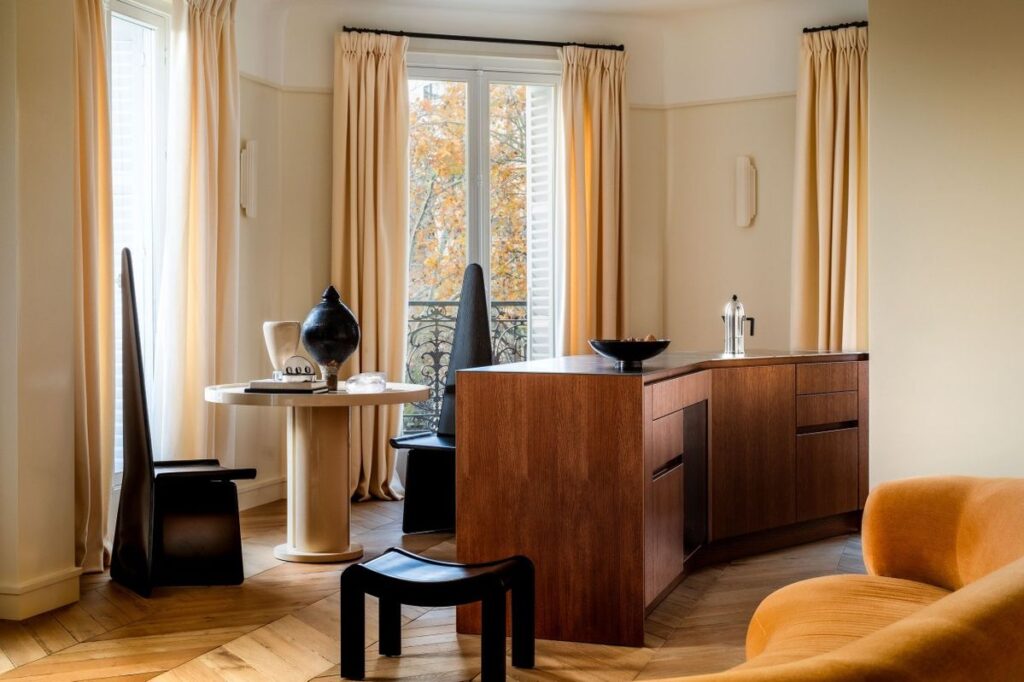
The second kitchen takes an entirely different approach.
Instead of disappearing, it settles.
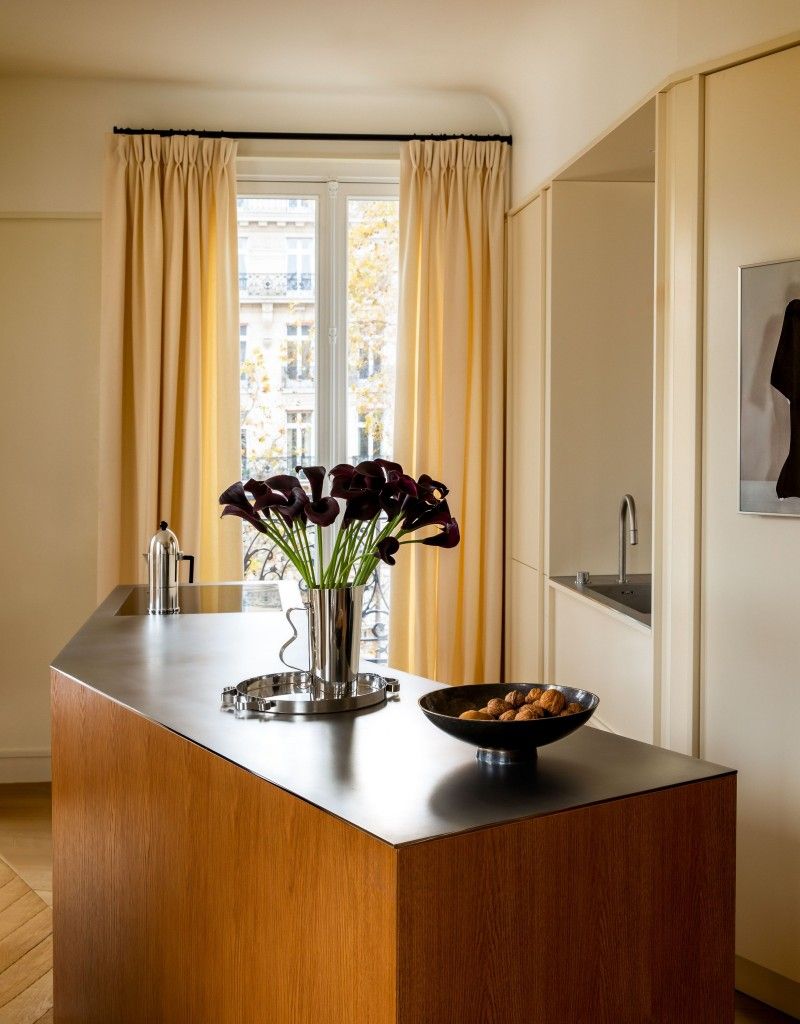
A warm timber island sits quietly in the room, its proportions closer to furniture than fitted cabinetry. Stainless steel is present, but understated — functional rather than expressive. Soft curtains filter daylight, and sculptural chairs share the space naturally, without hierarchy.
This kitchen doesn’t feel technical.
It feels domestic.
Rather than carving out a “kitchen zone”, it allows cooking, dining, and living to overlap. There’s no performance here — just calm, material honesty.
In a small home, this matters. When space is limited, dominance can feel exhausting. This kitchen avoids that by grounding the room emotionally. It’s designed to be lived with daily, not admired from a distance.
3. The Kitchen That Expresses Personality
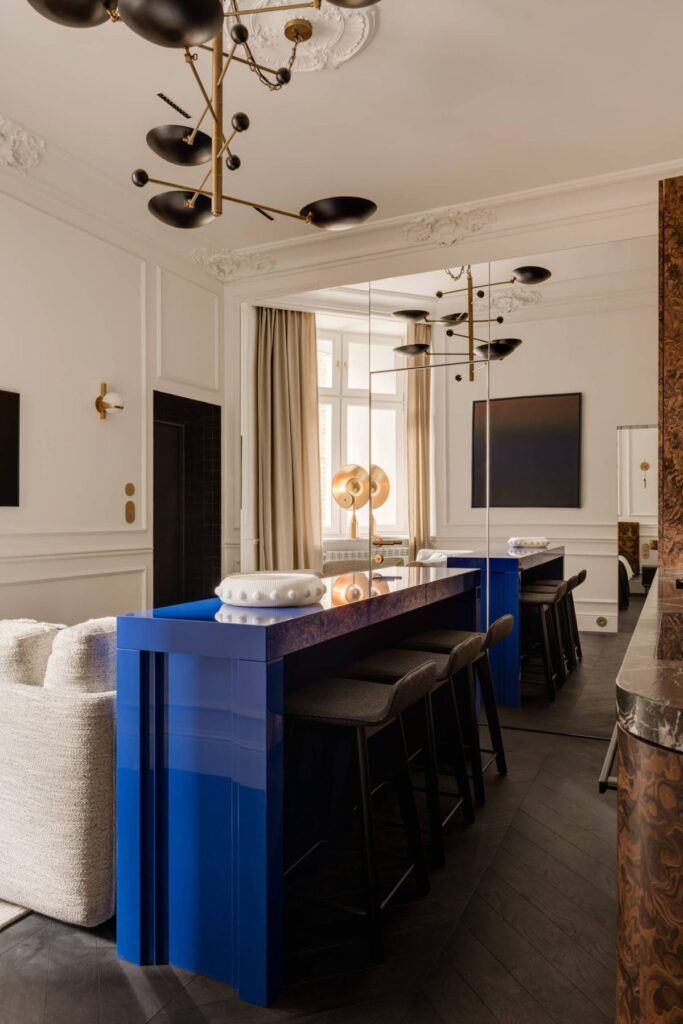
The third kitchen is more assertive — and unapologetically so.
A bold blue island anchors the space, paired with richly veined stone, sculptural lighting, and carefully mixed references. Classical detailing meets contemporary surfaces; colour meets control.
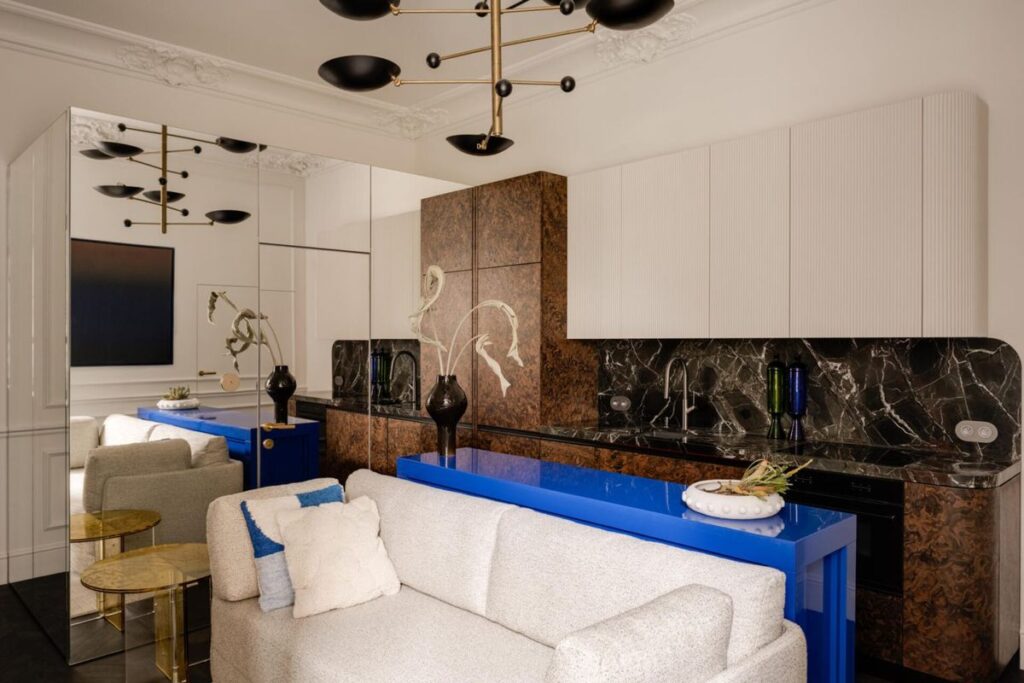
What makes this work in a small apartment is editing.
Nothing here is accidental, but nothing is excessive either.
The blue island acts as furniture — a visual and social anchor — rather than a block of cabinetry. It defines the space without overwhelming it. The kitchen becomes expressive, but still disciplined.
This is a reminder that small kitchens don’t need to be neutral to be successful. They just need clarity. When colour and material are chosen intentionally, personality becomes an asset, not a risk.
The Kitchen That Steps Back
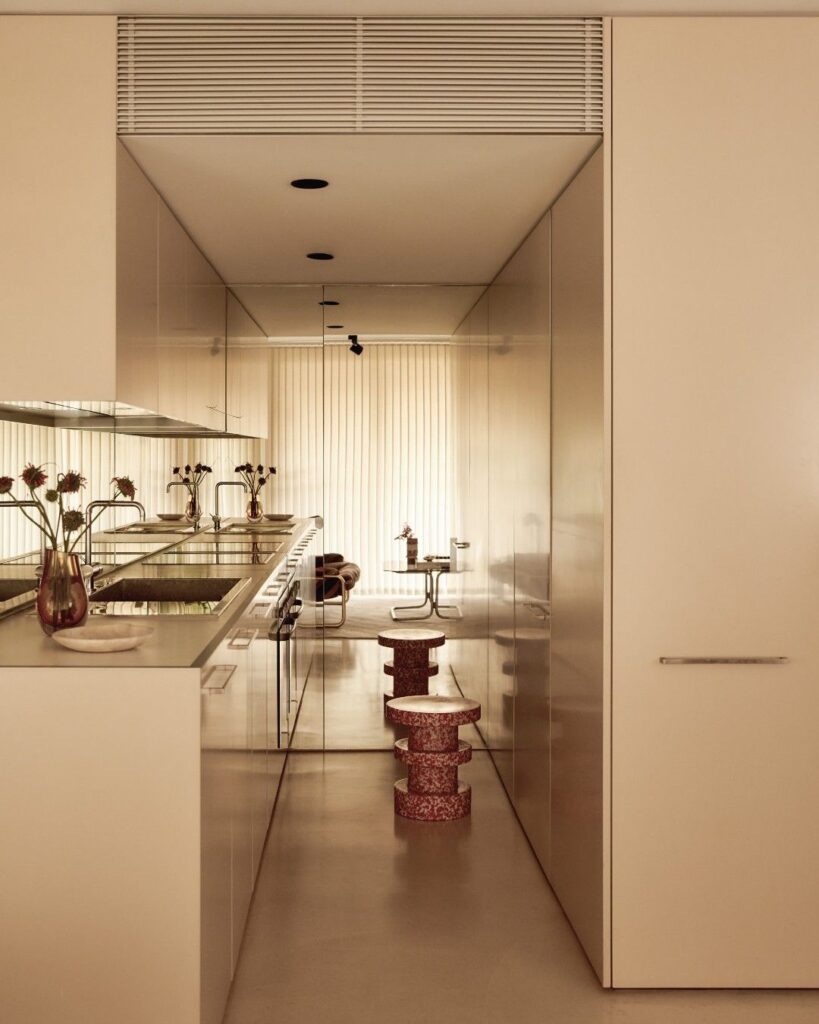
The final kitchen takes the most restrained position of all.
Long, linear, and almost corridor-like, it treats the kitchen as a passage rather than a destination. Continuous surfaces and reflective materials keep the visual noise low, allowing light and movement to flow through the space.
Here, the kitchen deliberately steps back so the rest of the home can step forward.
This approach works particularly well in narrow or elongated flats, where interruption would feel heavy. The kitchen supports daily life quietly, without demanding attention.
It’s not about minimalism as a style — it’s about respect for the plan.
These kitchens share one thing in common: none of them are trying to be “perfect”. Instead, each responds to context, scale, and the way people actually live. Some disappear. Some ground. Some express. Some support.
Small kitchens don’t fail because they’re small. They fail when they’re treated as problems instead of participants.
Design, at its best, isn’t about finding a single answer, it’s about choosing the right attitude.
KANDO STUDIO works with homeowners across West London to create interiors that respond to how spaces are lived in, not just how they look. For inquiries: [email protected]. See our work here